

Turn your website into a
patient acquisition engine.
Healthcare practices that invest in authority-driven content strategy earn better search rankings, build lasting patient trust, and convert searchers into appointments — consistently.
THE CHALLENGE
Healthcare marketing has a content problem.
Virtual care erased your geographic advantage. Your competition is national. Most practices still market like it's 2012.
01
Reactive content without strategy
One-off blog posts, campaign-driven articles, trending topic chases — they look like effort but don't build search authority or patient trust.
02
Lost before the first click
If your practice doesn't appear in condition-related search results, patients never reach your website. Ranking requires owning topics, not just publishing content.
03
The credibility gap
52% of Americans distrust health content they read online. Authoritative, well-structured content is how your practice earns the click — and the appointment.
WHAT WE DO
A complete content strategy. Not just content.
The jooj builds authority-driven content systems for healthcare practices. We connect patient behavior, search intent, and your clinical expertise into a strategy that works long after the campaign ends.
01
content strategy and planning
We audit your current digital presence, map patient search behavior, and define the topic clusters your practice can own. The result: a prioritized roadmap that drives organic visibility for the conditions and procedures that matter most to your growth.
04
reputation management
94% of patients read provider reviews before booking. We build content systems that encourage satisfied patients to share their experience, and we help your practice respond to feedback in ways that reinforce credibility.
02
authority-driven SEO content
We build pillar pages and supporting content clusters around your specialties — condition guides, procedure explainers, patient FAQs — optimized for the terms patients actually search. Plain language, mobile-friendly, E-E-A-T compliant.
05
content governance & measurement
Medical guidelines change. Provider info shifts. Outdated content undermines trust and rankings. We establish an audit schedule and tracking framework so your content stays accurate, performing, and aligned with your growth goals.
03
web content development
Patient-centered copy for every page: homepages, service pages, provider bios, location pages. We write for trust and conversion — making it easy for patients to understand your services and take the next step.
CONTENT FORMATS
Every format built for patient trust.
Healthcare content doesn't just need to rank — it needs to earn trust and move patients to act. We work across the formats that do both.
01
condition and treatment guides
Plain-language explainers that answer patient questions at every stage of the search journey.
04
pre-visit resources
Downloadable instructions and checklists that reduce no-shows and improve the patient experience from day one.
02
provider profiles
Bios, credentials, clinical philosophy and personal voice — the content that converts health consumer researchers into patients.
05
blog & editorial content
Consistent, search-optimized publishing that grows your topic authority over time without overwhelming your staff.
03
patient education video
Scripts and briefs for procedure animations and educational content that builds confidence before the appointment.
06
infographics & social assets
Repurposed content that extends your reach across social platforms and healthcare directories.
BY THE NUMBERS
The case for content strategy in healthcare
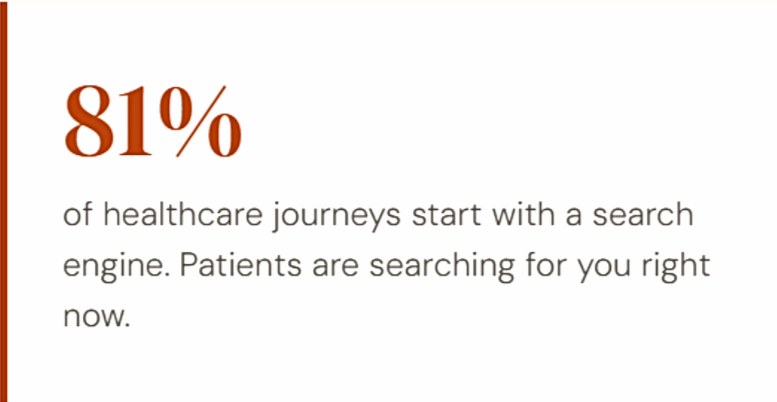
81%
of healthcare journeys start on a search engine
73%
of Americans get health information from the internet
41%
of patients say social media influenced their choice of provider
99%
of healthcare companies report positive results from content marketing
COMMON QUESTIONS
Things practices ask us first
Content strategy can feel abstract. Here's what it actually looks like in practice.
-
Content strategy covers the full lifecycle — what to publish, where to share it, how often, and how to keep it accurate over time. Content marketing is a subset that executes specific tactics to build trust and attract patients. Strategy sets the rules; marketing runs the plays. We do both.
-
Consistency matters more than volume. Two to four high-quality pieces per month outperforms daily publishing without a plan. We build schedules that cover your most important topics without overwhelming your team or straining your budget.
-
Usually not. A single domain with location-specific pages and specialty sections is more effective — and much easier to maintain. Separate sites split your authority and create duplication problems. Our content cluster approach gives each location and specialty its own visibility on one domain.
-
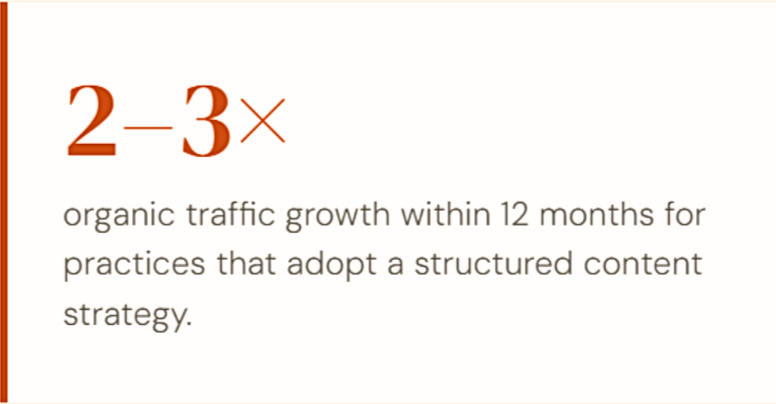
Organic search improvements typically start within three to six months of consistent publishing. Practices that commit to a full authority-driven content strategy can see significant traffic growth within twelve months. Competition and execution quality both factor in — we'll set realistic benchmarks during your consultation.
-
Yes. We work with dermatology, dental, therapy, primary care, specialty care practices and professional services businesses across the US. Virtual care erased geographic limits for your competitors — and for our clients too.
-
They pull from the page content — almost exclusively.
The meta description (also called the SEO snippet) is not a ranking signal and hasn't been for years. Google stopped using it for ranking in 2009. AI crawlers and large language models read the actual body content: headings, paragraphs, lists, structured data. The meta description might occasionally appear as the blurb under a search result, but it is not what the bot uses to formulate an answer.
This has implications for how you write. When building your web content, you need to be mindful of clarity, conciseness and authority and you have to show it quickly.
If you bury the answer in paragraph four under a vague subhead, the AI might miss it or misattribute it. In fact, it probably will miss it and then that search query snippet pulled into AI answers goes to someone else. A competitor of yours, most likely. If you put your query + answer in a clean H2 followed by a direct answer in the first sentence below it, the AI is far more likely to surface it.
For GEO specifically, structure matters as much as substance. AI crawlers favor content that is:
Organized under clear, descriptive subheads.
Written in direct, declarative sentences.
Free of marketing preamble before the answer.
Backed by signals of authority (citations, credential references, schema markup).
So if you want a specific answer to appear in an AI-generated response, put it in the page body under a heading the AI can parse as relevant to the query. The snippet will not save you.
-
If it's built with accordion boxes, the answer is mostly yes, with one important catch. Crawlers read raw HTML, not what's visually expanded on screen. As long as your answers are in the page source from the start (not loaded dynamically after a click), they're being read. Add FAQ schema markup and you're giving AI search systems a direct signal to cite your content. The full explanation — including what DOM means and why it matters — is on the jooj blog. https://www.thejooj.com/can-ai-crawlers-read-accordion-boxes
-
Both, honestly. But mostly yes, and the distinction matters.
AI has changed search. Google's AI Overviews now combine information from multiple sources, turning Google into both a search engine and an answer engine. As a result, 58.5% of U.S. Google searches now end without a click to any website.
That's a real shift, but not a replacement. AI can provide fast answers, yet it can also oversimplify complex topics or occasionally be wrong. Meanwhile, despite ChatGPT's explosive growth, Google still processes hundreds of times more searches each day. More than 95% of Americans continue to use traditional search engines regularly.
The hype is the claim that AI has replaced search. The reality is that search is evolving, not disappearing. The results page has changed, AI is increasingly part of the experience and fewer users click through to websites, but Google remains the starting point for most online discovery.
READY TO START?